
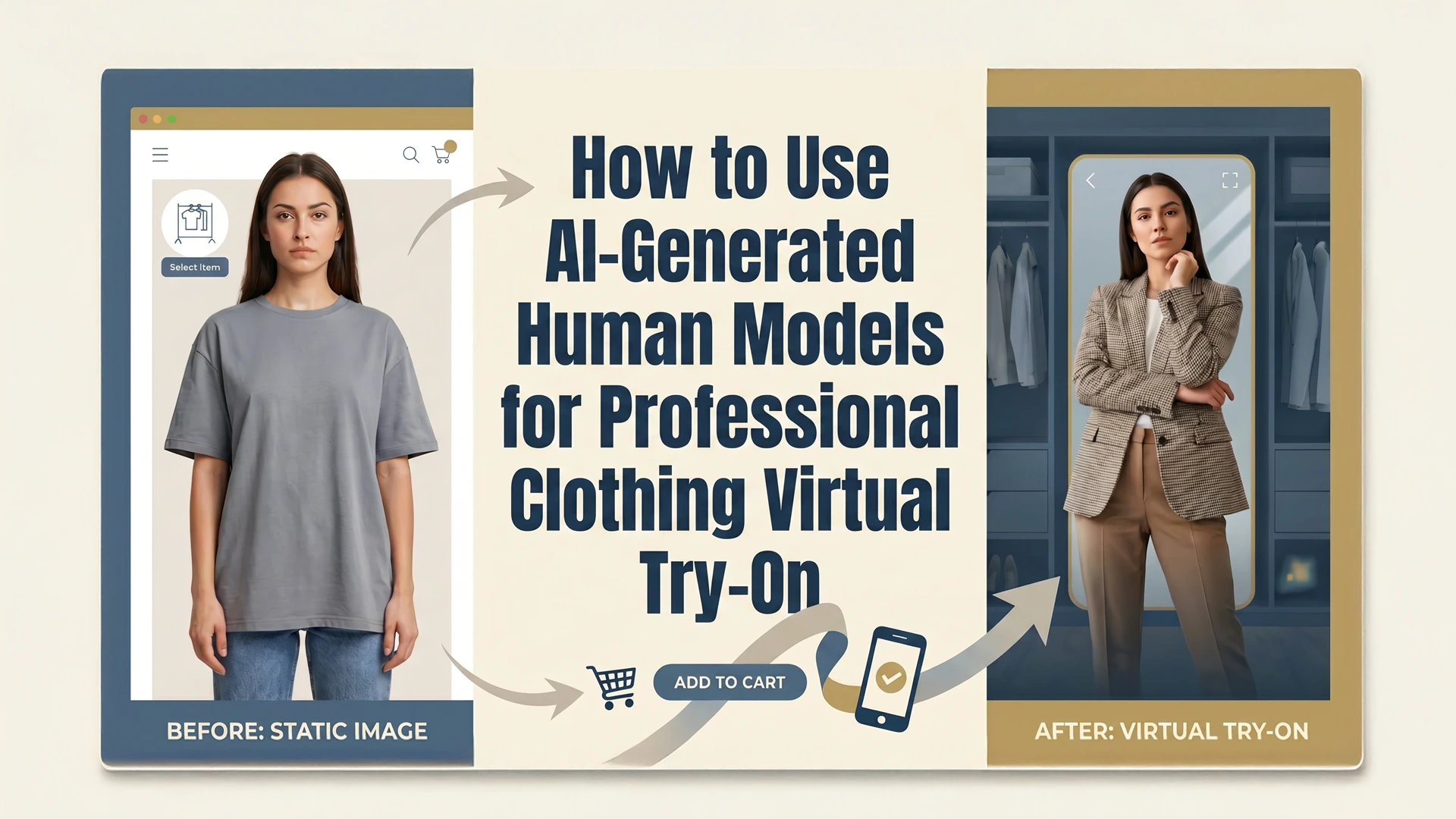

If you are running a clothing brand in the US or UK, you already know what professional model photography costs. Studio product photography in the US typically runs $40 to $60 per image, while UK rates sit at £25 to £50 per image — and that is before you factor in freelance model fees, which average £30 to £50 per hour according to the Professional Models Association (PMA). For a diverse catalogue shoot across multiple body types, those costs compound fast. And the moment you want to show your garment on a different model, a different build, or a different skin tone? You are booking another shoot.
(Pricing sources: Squareshot US/UK Studio Rates | Freelancer Club PMA Model Rates 2025)
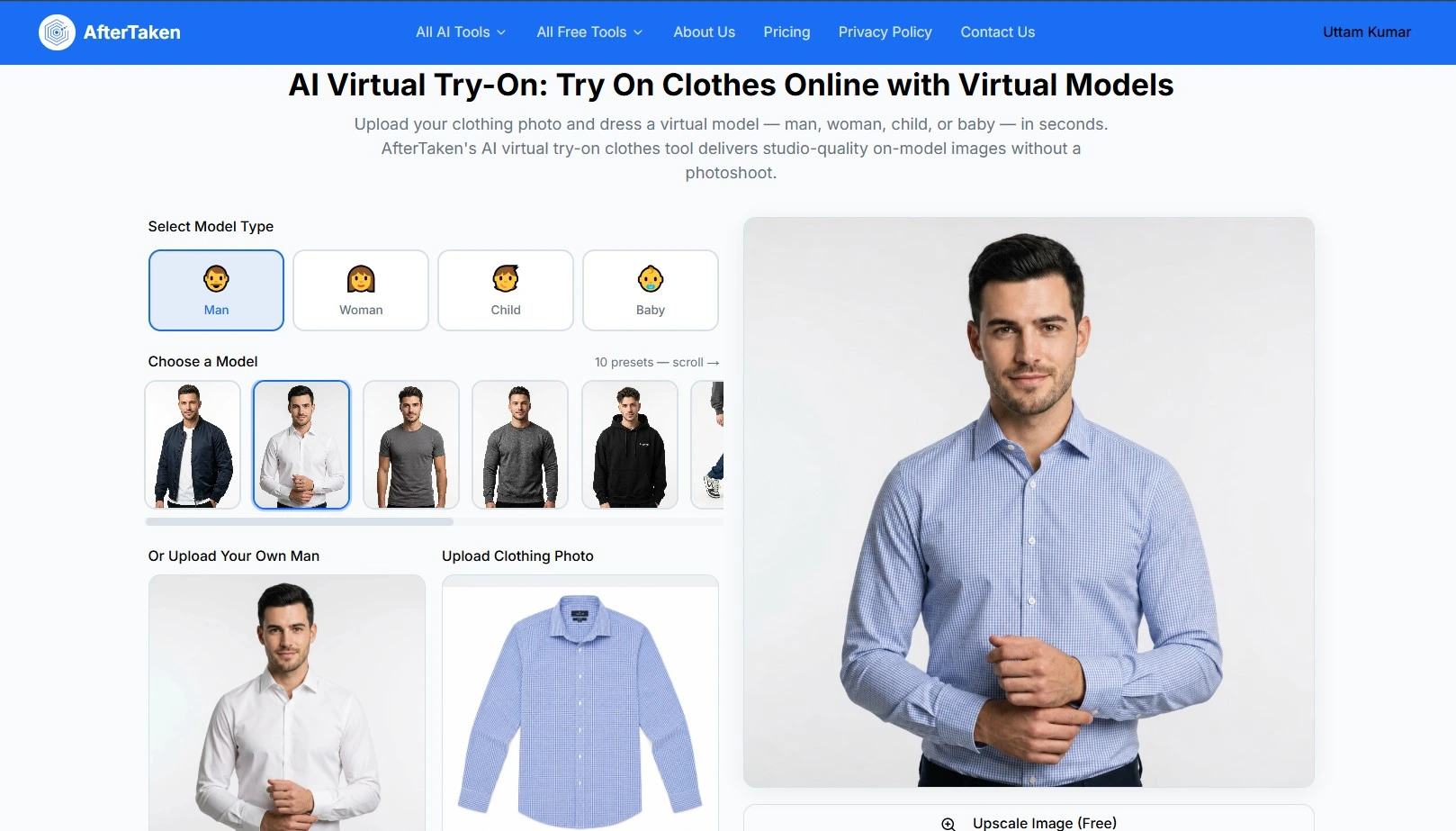
This is exactly the problem that AI virtual try-on technology has solved — quietly, efficiently, and at a fraction of the cost. With AI-generated human models, clothing brands can now try on clothes virtually across a diverse range of body types, skin tones, and styles — without hiring a single model or booking a single studio. The results are professional, realistic, and ready to publish in under two minutes. In this guide, I am going to walk you through exactly how to use AfterTaken’s AI virtual try-on tool to select AI-generated models and generate professional virtual try-on clothing images for your brand — step by step.
Why US and UK Clothing Brands Are Switching to AI-Generated Models
The shift toward AI virtual try-on clothes is not just about cutting costs — though it does that dramatically. It is about something US and UK consumers have been pushing for for years: representation and diversity in fashion photography. Studies consistently show that shoppers are significantly more likely to purchase a garment when they can see it modelled on someone who looks like them. A single model shoot, no matter how well executed, only speaks to one demographic. An AI clothes changer that lets you generate the same garment on models of different body types, skin tones, and ages speaks to every customer who lands on your product page.
From my experience working with clothing brands: the conversion difference between a single-model listing and a multi-model virtual try-on listing is not subtle. Buyers engage longer, bounce less, and return less when they can see a garment on a body that resembles their own.
- Diversity matters to modern shoppers — 67% of US consumers say they want to see more diverse body representation in clothing ads
- Returns are lower when buyers can virtually try on clothes online before purchasing — they know what to expect
- AI virtual try-on fashion lets you show the same garment across multiple demographics simultaneously
- Speed to market increases — launch new collections with full model imagery the same day the samples arrive
- Amazon virtual try-on clothes and similar marketplace features are becoming standard expectations for buyers
What Are AI-Generated Human Models — and Are They Realistic Enough?
This is the question I get asked most often by brand owners who are new to AI clothing try-on technology. The short answer is: yes, modern AI-generated models are realistic enough for professional ecommerce product listings — and they are improving every month.
AfterTaken’s AI does not use pre-rendered static mannequins or cartoonish avatars. It generates photorealistic human models that respond to the actual structure of your uploaded garment — adapting drape, shadow, and fit based on the fabric and cut of the item. The result looks like a genuine model photo, not a digital illustration.
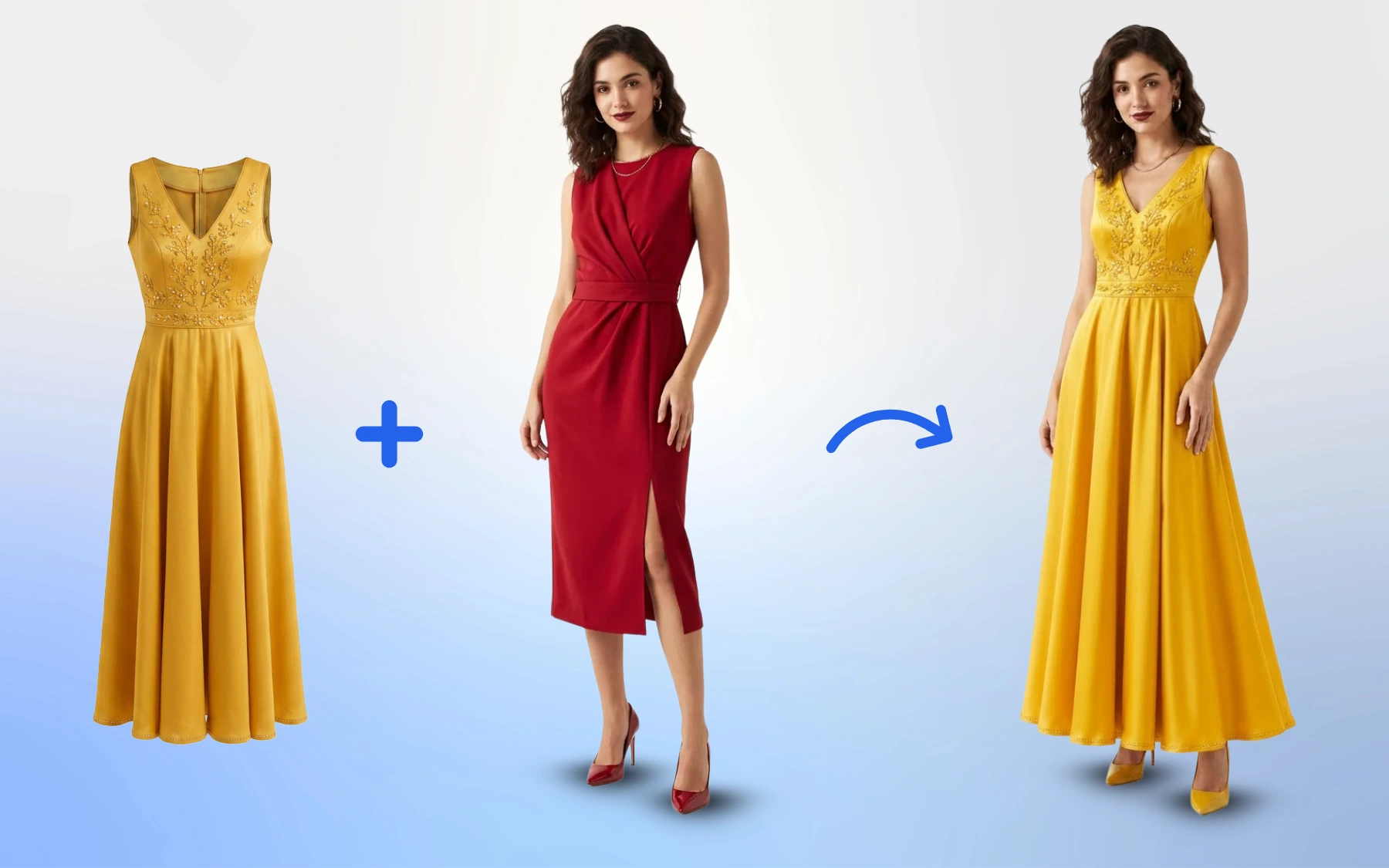
Model Options Available in AfterTaken:
| Model Attribute | Options Available in AfterTaken |
|---|---|
| Body Type | Slim / Athletic / Regular / Plus-size — multiple builds available |
| Skin Tone | Fair, Medium, Olive, Brown, Dark — full spectrum representation |
| Gender | Male, Female, and gender-neutral model options |
| Age Appearance | Young adult, mid-age, and mature model aesthetics |
| Pose Style | Neutral standing, casual, confident, editorial |
| Background | Clean white, lifestyle, studio grey — or custom |
This level of model diversity — available instantly, at scale, with no additional cost per variation — is simply not achievable with traditional model photography for the vast majority of clothing brands. It is one of the most significant practical advantages of AI virtual try-on clothes online technology for brands targeting diverse markets like the US and UK.
Step-by-Step: How to Generate Professional Virtual Try-On Images with AI Models
Here is exactly how the process works on AfterTaken’s platform. I have kept this as practical as possible — this is the actual workflow, not a simplified overview.
| # | Action | What Happens |
|---|---|---|
| 01 | Open AfterTaken Virtual Try-On | Go to aftertaken.com/tools/virtual-try-on — no app download, no signup required to explore. |
| 02 | Upload your garment photo | Use any existing product image — flat-lay, mannequin, or hanger shot. Clean background works best. |
| 03 | Select your AI-generated model | Browse the model library. Filter by body type, skin tone, gender, and pose to match your target audience. |
| 04 | AI maps the garment onto the model | The AI clothes changer analyses garment structure, drape, and fit — then places it on the selected model naturally. |
| 05 | Preview and adjust | Review your virtual try-on result. Regenerate with a different model or background in one click if needed. |
| 06 | Download and publish | Your professional virtual try-on clothing image is ready. Use it on your store, ads, social — anywhere. |
What Types of Garments Work Best for AI Virtual Try-On?
Based on my hands-on testing with AfterTaken’s AI clothing try-on tool, here is a clear breakdown of what works exceptionally well and where you might want to set realistic expectations:
Works Exceptionally Well:
- Shirts, blouses, and tops — the AI handles collars, buttons, and sleeves with high accuracy
- Dresses and skirts — length, flow, and waistline are rendered naturally on the selected model
- Outerwear — jackets, coats, hoodies — structure and layering translate very cleanly
- Trousers and jeans — fit, rise, and leg width are preserved accurately across body types
- Knitwear and sweatshirts — fabric texture and drape render well in the virtual outfit try-on
Works With Minor Limitations:
- Very sheer or heavily embellished fabrics — intricate beading or lace detail may simplify slightly
- Extremely oversized or unstructured garments — where drape is unpredictable even on a real model
- Full-length coats below the knee — results are good but may need a review before publishing
| Method | Cost | Turnaround | Limitation |
|---|---|---|---|
| Professional Studio Shoot (US) | $40 – $60 per image + model fees | 3–7 days | 1 model, 1 body type |
| Professional Studio Shoot (UK) | £25 – £50 per image + model fees | 3–7 days | Limited diversity |
| Freelance Model Rate (UK) | £30 – £50 per hour (PMA survey) | Per booking | Separate from shoot cost |
| AfterTaken AI Virtual Try-On | $0.10 – $0.20 per image (approx) | 1 to 3 minutes | Any model, any variant |
The math is straightforward. At $40–$60 per image in the US and £25–£50 in the UK — plus model fees averaging £30–£50 per hour — a 100-piece catalogue shoot with even basic diversity across two or three model types can quickly run into thousands of dollars or pounds. The same catalogue processed through AfterTaken’s AI virtual try-on tool — with multiple AI model variants per garment — costs under $20 to $25 in total.
Pricing Sources & References US/UK Studio Rates ($40–$60 / £25–£50 per image): Squareshot — Product Photography Rates Guide (2025)
UK Model Rates (£30–£50/hr, PMA Survey): The Freelancer Club — Freelance Model Rates 2025
UK Photographer Day Rates (£500–£1,000/day): Ross Jukes Photography — UK Photography Rates GuideThis is not a small saving. For an independent clothing brand or a growing D2C label, the difference between those two numbers is the difference between being able to afford inclusive, diverse model photography — or not.
How AI Virtual Try-On Supports Inclusive Fashion Marketing
One of the most important conversations happening in US and UK fashion retail right now is around size inclusivity and representation. Consumers — particularly Gen Z and Millennial shoppers — actively choose brands that show their products on diverse bodies. They notice when a brand’s model photography skews narrow, and they take their purchase elsewhere.
AI virtual try-on fashion makes genuine inclusivity achievable for brands of every size. You are no longer limited by the budget required to book models of different sizes and backgrounds for separate shoots. With AfterTaken’s AI clothes changer, you select the model attributes that reflect your customer base — and the technology handles the rest.
In practice, this means a small independent women’s clothing brand can show every dress on models ranging from size 6 to size 20 — and every body type gets to see themselves in the garment. That is the kind of customer experience that builds genuine brand loyalty.
- Show plus-size virtual try-on clothing without booking separate plus-size model shoots
- Represent different skin tones across your entire catalogue — not just hero products
- Generate male and female model variants for unisex or gender-fluid collections
- Test how garments photograph on different body proportions before committing to production decisions
- Build a try on clothes online virtual model experience directly into your product pages
Using AI-Generated Try-On Images Across Your Marketing Channels
One thing I have found consistently in working with clothing brands: the images generated through AI virtual try-on clothes online are not just useful for product listing pages. They are versatile enough to use across your entire marketing mix — and that multiplies their value significantly.
Where to Use Your AI Virtual Try-On Images:
- Product listing pages — primary use case; increases conversion and reduces returns
- Instagram and TikTok ads — AI model images perform well in paid social, especially for retargeting
- Email campaigns — use different model variants in segmented campaigns to match your audience demographics
- Google Shopping — clean, professional model images improve click-through rates versus flat-lay or mannequin photos
- Lookbook and catalogue PDFs — generate an entire seasonal lookbook without a single model booking
- Amazon and Etsy listings — platforms are increasingly favouring model photography over flat-lay in ranking algorithms
AfterTaken vs Other AI Virtual Try-On Tools: What Sets It Apart?
- Ecommerce-first design — built for catalogue-scale output, not just individual consumer use
- Realistic garment mapping — the AI understands fabric, structure, and drape rather than simply overlaying a flat image
- Diverse AI model library — wider range of body types, skin tones, and poses than most competing tools
- No app required — entirely browser-based, works on Mac, PC, or tablet without installation
- Ghost mannequin + virtual try-on in one platform — the only tool I have found that handles both workflows
- Free credits for new users — test the quality on your actual garments before committing to a paid plan
- Speed — 1 to 3 minutes processing time makes it viable for large catalogue runs, not just one-off tests
For US and UK clothing brands that need both invisible mannequin product photography for their listing pages and AI virtual try-on images for their marketing, having both in a single platform is a genuine operational advantage.
Final Thoughts: The Model Shoot Is No Longer a Gatekeeper
For a long time, professional model photography was the single biggest barrier between a clothing brand’s vision and its ability to execute that vision at scale. You needed budget, you needed logistics, you needed time — and even then, you were limited to one model, one session, one look.
AI virtual try-on technology has removed that barrier entirely. Brands in the US and UK that understand this — and move on it now — are going to be operating at a structural advantage over competitors who are still booking shoots the traditional way. The ability to try on clothes online with virtual models, swap outfits instantly with an AI clothes changer, and generate diverse model imagery at scale is not a futuristic capability. It is available today, it takes two minutes per image, and it costs a fraction of a cent per output.
The question is not whether your brand should be using AI virtual try-on. The question is how quickly you can integrate it into your catalogue workflow — and start seeing the conversion and return-rate results that come with it.
Frequently Asked Questions (FAQs)
AI Virtual Try-On is a technology that allows fashion brands to digitally map apparel from flat-lays, hangers, or ghost mannequin shots onto photorealistic AI human models. The AI analyze the garment’s structure, fabric drape, folds, and lighting to automatically and naturally fit it onto a selected model’s body shape.
Modern AI technology does not create cartoonish avatars or rigid, artificial figures. Advanced platforms generate hyper-realistic human models with precise fabric draping and natural shadow rendering. The output matches professional studio standards, making it indistinguishable from traditional photography on e-commerce listings.
Traditional studio photography generally runs between $40 to $60 (or £25 to £50) per image, before adding hourly freelance model fees. With AI Virtual Try-On, the operational cost drops to just cents per image. This represents an immediate cost reduction of up to 99% for catalog production.
Most standard apparel categories deliver exceptional results, though a few intricate styles have minor limitations:
Excellent Results: Shirts, blouses, tops, dresses, skirts, jackets, hoodies, trousers, jeans, and knitwear.
Minor Limitations: Highly transparent/sheer fabrics, heavily embellished items (dense beading or complex lace), and extremely oversized, unstructured silhouettes.
Not at all. Platforms like AfterTaken are entirely browser-based and designed for simple e-commerce operations. The workflow takes under 3 minutes: upload a clean photo of your garment, select your model presets, and click generate to download your high-resolution asset.

The cost comparison really highlights why so many apparel brands are exploring AI-generated models, especially when they need to showcase the same product across different body types and skin tones. One thing I find interesting is how this could also speed up seasonal catalog updates and A/B testing for ads without the usual production delays. Curious to see how brands balance efficiency with maintaining a consistent visual identity over time.
Thanks for sharing your thoughts! You made a great point about AI-generated models helping brands scale product presentations across different body types and styles while reducing production delays. The balance between efficiency and maintaining a strong visual identity is definitely going to be one of the biggest challenges — and opportunities — for fashion brands moving forward. Excited to see how this space evolves as AI workflows become more refined and brand-focused 😃
The breakdown of the rapidly compounding costs for diverse studio shoots really highlights why the industry is shifting toward AI models so quickly. It is especially powerful that brands can now instantly visualize garments on varied body types and skin tones without the logistical headache of booking another session. This approach seems to solve the biggest hurdle of inclusive representation at a fraction of the traditional price point.
Thanks for the thoughtful insight! You’re absolutely right — the ability to quickly visualize products across diverse body types and styles without organizing multiple shoots is becoming a major advantage for modern fashion brands. AI-generated models are not only reducing production costs, but also making experimentation, personalization, and inclusive representation much more scalable. It’ll be interesting to see how brands combine AI efficiency with authentic brand storytelling in the coming years 😃
The breakdown of model photography costs in the US and UK really highlights how quickly expenses compound when trying to achieve true diversity without constant reshoots. Leveraging AI to scale across different body types and skin tones in under two minutes must be a game-changer for brands looking to modernize their catalogs while staying lean.
Thanks for your thoughtful perspective. Cost efficiency is definitely one of the biggest advantages, but what’s equally exciting is the ability to adapt campaigns for different audiences almost instantly. Brands can test multiple body types, styles, and demographics without the traditional time and budget constraints, making personalization far more accessible than ever before.
The breakdown of the hidden costs behind traditional diverse model shoots really highlights why brands are pivoting to AI solutions. Moving beyond just saving money, the ability to instantly generate varied body types and skin tones opens up new marketing possibilities that were previously too expensive or logistically complex to achieve.
The point about testing across body types before a full shoot is useful. In short campaign workflows, turning product stills into motion previews can also help teams compare variants earlier. ClipTrend.ai is one option for creators who want to turn images into short AI video clips.
That’s a very solid point! Moving from static images to motion previews is indeed a game-changer for evaluating variants before committing to a full shoot. ClipTrend.ai sounds like a great tool for creators looking to bridge that gap. Thanks for sharing this insight!